The following is the third edition of a monthly series chronicling the U.S. 2016 presidential election. It features original material compiled throughout the previous month after an overview of the month's biggest stories.
In this month's edition on the campaign trail: two individuals previously interviewed by Wikinews announce their candidacies for the Reform Party presidential nomination; a former Republican Congressman comments on the Republican National Convention; and Wikinews interviews an historic Democratic National Convention speaker.
Contents
Summary[edit]
As July started, presumptive Democratic Party presidential nominee Hillary Clinton met with the FBI to discuss the private e-mail server she used as Secretary of State. A few days later, FBI Director James Comey held a press conference where he announced that charges would not be appropriate against Clinton. He noted, however, that Clinton had acted carelessly in installing a private e-mail server for State business and had risked compromising State secrets. Presumptive Republican nominee Donald Trump tweeted that the lack of charges in the case showed "the system is totally rigged!" Polls from the early part of the month gave Clinton a slight lead in the race. She led the July 4 Real Clear Politics average 44.9% to 40.3%. At this time, media interest in the running-mate selections of Trump and Clinton intensified. The Washington Post speculated that New Jersey governor Chris Christie and former House Speaker Newt Gingrich were the leading contenders to be Trump's running mate. However, other reports pointed to Indiana governor Mike Pence, who confirmed he would accept the position if asked. Trump commented that ten names were on the shortlist including some not mentioned in the media. In later days, General Michael Flynn was floated as a possibility in reports. Gingrich, Flynn, and Pence were apparently finalists for the position, with Pence believed to be the favorite. For the Democrats, Senator Cory Booker, Congressman Xavier Becerra and Secretary of Housing and Urban Development Julian Castro received mention as potential running mates for Clinton, but the shortlist reportedly included Senators Elizabeth Warren, Tim Kaine, Labor Secretary Thomas Perez, and Agriculture Secretary Tom Vilsack.
.jpg)
Image: Max Goldberg (flickr).
On July 7, Trump arrived in Washington D.C. and met with Republican members from the House of Representatives and Senate. During the meeting, Trump reportedly told the attendees if they did not support his candidacy, they were, in effect, supporting Clinton. Trump agreed to allow his former rival, Senator Ted Cruz, to speak at the convention, but he did not secure an endorsement from Cruz. The next day, both Trump and Clinton canceled campaign events as an African American shooter in Dallas killed five police officers. Trump's state chairman in Virginia blamed the shooting on Clinton and others "who label police as racists." In the aftermath, Trump proclaimed himself the "law and order candidate." Ahead of its convention, the GOP platform committee approved a socially conservative platform that opposed same-sex marriage and identified pornography as a "public health crisis." The convention's host, Ohio governor John Kasich, a former presidential rival of Trump, would not endorse Trump and claimed through a spokesman that Trump had asked Kasich join the presidential ticket in May, but Kasich had declined. Trump's spokesman denied the claim. Another former rival, former Florida governor Jeb Bush, said he might vote for Libertarian Party presidential nominee Gary Johnson instead of Trump. On the other side, Hillary Clinton's principle rival, Senator Bernie Sanders, dropped his campaign and officially endorsed Clinton. Clinton also seemingly received support from Supreme Court Justice Ruth Bader Ginsburg who called Trump "a faker" and wondered why he has "gotten away" with not releasing his tax returns. Democratic Senator Chris Murphy questioned whether the country was "well served" with a Supreme Court justice openly discussing her political views. Trump referred to Ginsburg's comments as "highly inappropriate." Ginsburg later apologized.
Trump announced he would officially name his running mate on July 15. Though Pence was the favorite to receive the nod, Trump met with Senator Jeff Sessions, and had additional meetings with Christie and Gingrich. According to multiple news reports, Trump's daughter Ivanka, her husband Jared Kushner, and financier Sheldon Adelson all tried to convince Trump to select Gingrich, while campaign manager Paul Manafort favored Pence, and pollster Tony Fabrizio wanted Flynn. CNN reported Trump had offered the position to Pence, who accepted. According to NBC, the purported leak of the news had left Trump "seething." Due to the July 14 attack in Nice, France, Trump postponed the planned announcement. Both CNN and NBC reported Trump was looking for ways to get out of the selection of Pence. The campaign denied the report. The New York Times alleged the Pence selection was revisited because Christie had begged the campaign to reconsider its decision and replace Pence with himself. On July 15, Trump officially announced via Twitter that he had selected Pence. Through the selection, Trump said he hoped to unify the party. Manafort said the ticket would appeal to former supporters of Sanders. As the GOP convention approached, Manafort declared the #NeverTrump movement "gone," as the GOP rules committee voted not to unbind delegates. Clinton announced she would reveal her vice presidential selection after the GOP convention. The Washington Post tapped Vilsack as the favorite.
RNC[edit]

As the GOP convention began in Cleveland, Ohio, Trump trailed Clinton in the July 18 Real Clear Politics average 40.6% to 43.8%. Although Ohio was hosting the convention, the state's delegates were not placed in the front as is tradition. This was believed to be punishment for Governor Kasich's refusal to endorse Trump or attend the convention. Manafort called Kasich's absence a "big mistake" and "embarrassing [to] his state." With the release of the lineup of speakers showing many members of Trump's family, former RNC chairman Michael Steele called the convention "a [Trump] family affair."
On the opening day, on the floor of the convention at Quicken Loans Arena, anti-Trump delegates unsuccessfully attempted to force a roll call vote on the convention rules. Protests outside were relatively minor with only 24 arrests throughout the entire convention. During the convention speeches, delegates frequently chanted "Lock her up!" in reference to Hillary Clinton. Patricia Smith, mother of diplomat Sean Smith who died in the 2012 Benghazi attack, blamed Clinton for her son's death and exclaimed, "Hillary belongs in prison. She deserves to be in stripes." In his speech, former New York City Mayor Rudy Giuliani commented Clinton "would go to jail" if he were allowed to prosecute her. In the prime-time opening-night speech, Trump's wife Melania delivered a speech that initially received acclaim. However, this changed once the media pointed out some lines were nearly identical to those from the speech of First Lady Michelle Obama at the 2008 Democratic National Convention.
.jpg)
The Trump campaign spent most of the second day of the convention explaining away the plagiarism flap as speechwriter Meredith McIver took the blame for the passages and offered to quit. Trump requested she remain. Trump officially received the presidential nomination on the second day of the convention and Pence received the vice-presidential nomination. Christie delivered a speech in which he held a mock trial prosecuting Clinton in absentia before the delegates. He was followed with prime-time speeches by Trump's children Tiffany and Donald Jr.

On the third day, The New York Times released a transcript of an interview with Trump in which he criticized NATO and questioned whether the US should honor the treaty if member nations do not contribute their share of funds. Several Republicans, including Senate Majority Leader Mitch McConnell, said they disagreed with Trump's comments. Disagreements seeped into the convention as well when Cruz gave a speech in which he did not endorse Trump. When his refusal became evident, a chorus of boos erupted from the delegates, continuing until he left the stage. The speech overshadowed that of Pence who accepted the vice-presidential nomination later that night. Cruz received almost universal condemnation from prominent Republicans. However, Gingrich, who spoke after Trump's son Eric, who followed Cruz, commented he did not take the speech to show a lack of support for Trump. Manafort and Donald Trump Jr. claimed it had helped Republicans unite behind Trump.
On the last day of the convention, after a formal introduction from Ivanka, Trump accepted the GOP nomination and delivered, CNN noted, the longest nominee acceptance speech in 40 years. In the speech, Trump emphasized "law and order", and referenced his proposals of building a wall along the southern border and banning immigration from nations with a history of terrorism. Trump described the legacy of his opponent Clinton as one of "death, destruction, terrorism, and weakness." President Barack Obama criticized the speech, accusing Trump of basing it on fear and inaccurately painting a bleak portrait of the nation. Nevertheless, a CNN/ORC instant poll showed 57% of respondents who watched the speech received it favorably and 56% were more likely to vote for Trump. According to pundit Joe Trippi, the speech and overall convention provided the GOP with about a 5.9% bounce in the polls, one point higher than the average. Most polls at this time showed Trump leading Clinton.
-

Tiffany Trump
-

Chris Christie
-
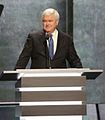
Newt Gingrich
-

Eric Trump
-

Ivanka Trump
_(cropped).jpg)
.jpg)
.jpg)
.jpg)
.jpg)

No comments:
Post a Comment